AI agent economy
The AI agent economy (also called agentic commerce when focused on shopping) is the emerging set of practices in which software agents—programmes that can plan multistep tasks with large language models and tools—discover services, negotiate or select offers, and pay other services or agents with limited human oversight. It spans consumer shopping assistants, enterprise workflow bots, and machine-to-machine API micropayments.[1]
Related: x402, AI agent domain registration, Buy a domain with USDC, Domain registration API.
What autonomous agents are
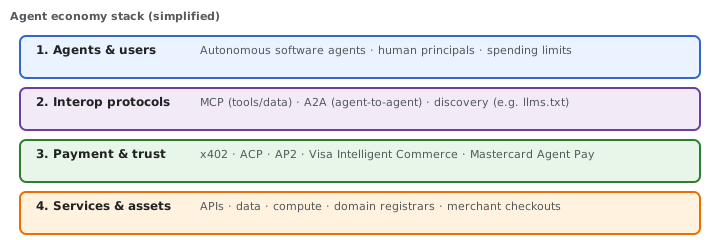
In this context an agent is software that can take a goal, call tools or APIs, keep intermediate state, and continue until a stopping condition—often with a human-set budget or policy. Agents may shop, book, register infrastructure (including domain names), or buy metered data. They are not a single product: platforms from OpenAI, Google, Anthropic, Cloudflare and others ship overlapping “agent” features with different safety and payment models.[1]
Interop protocols
- Model Context Protocol (MCP) — an open standard popularised by Anthropic for connecting models to tools, data sources and prompts in a structured way; widely used so agents can call registrar APIs, payment helpers or browsers as tools.[1]
- Agent2Agent (A2A) — an open protocol announced by Google for agent-to-agent capability discovery and task coordination over HTTP-style interfaces; complementary to MCP (tools vs peer agents).[2]
- Discovery files — machine-oriented site indexes such as
llms.txthelp agents find APIs and policies without scraping only human HTML (many registrars publish them alongside OpenAPI).
Payment rails (as of November 2026)
Several parallel standards address different layers of “an agent paid for something”:
| Rail / protocol | What it primarily does | Primary sources |
|---|---|---|
| x402 | Pay per HTTP resource with stablecoins (often USDC); HTTP 402 handshake. | [3][4] |
| Agentic Commerce Protocol (ACP) | Open checkout protocol for agents buying from merchants; Stripe docs credit Stripe, OpenAI and Meta; scoped payment tokens so agents need not hold raw card data. | [5] |
| Agent Payments Protocol (AP2) | Signed mandates proving what a user authorised an agent to buy; Google donated AP2 to the FIDO Alliance (April 2026) and released v0.2 with “Human Not Present” flows; samples include card and x402 settlement. | [6][7] |
| Visa Intelligent Commerce | Network programme (announced 30 April 2025) for AI-ready tokenised credentials, spend controls and partner APIs so agents can shop with Visa rails. | [8] |
| Mastercard Agent Pay | Mastercard programme for agentic tokens / trusted agent payments; Google’s AP2 donation post notes Verifiable Intent co-developed with Mastercard and donated to FIDO. (Mastercard product pages were intermittently unreachable during verification on 9 November 2026; treat live product URLs as authoritative.) | [6][4] |
These systems often compose: AP2 may prove user intent while x402 or a card token settles the payment.
Identity and trust
Classic e-commerce assumes a human clicks “buy”. Agents break that assumption, raising questions of authorisation, authenticity of intent, and accountability after errors or fraud—problems AP2 and card-network “trusted agent” designs explicitly target.[7] Visa’s Trust Index reporting (2026) found only 23% of surveyed U.S. consumers trusted generative AI to handle payments on their behalf, while a larger share said they would trust Visa to handle agentic transactions—illustrating brand and control as adoption bottlenecks.[9] Visa’s separate Agentic Commerce Benchmark (November 2026) reported selected models passing about 57% of realistic shopping test runs, with many failures still producing a purchase.[10]
Market-size estimates
Forecasts disagree on definitions (software spend vs orchestrated retail GMV). One cited figure from McKinsey’s October 2025 agentic-commerce report is that by 2030 global agentic-commerce revenue opportunity could reach about US$3–5 trillion, with U.S. B2C retail alone potentially on the order of US$0.9–1 trillion of orchestrated revenue (goods; services and B2B largely excluded).[1] Other analyst houses publish different agentic-AI software spend curves; this article does not treat any single forecast as settled fact.
Effects on domain names
- Agent-first registrars — APIs, MCP servers,
llms.txt, and programmable payments so agents can search, quote, register and configure DNS without a browser UI (StableDomains, Porkbun MCP/API docs). - Stablecoin / x402 checkout — agents pay USDC on Base (and other chains) for registrations and data endpoints; see x402 and Buy a domain with USDC.
- Agent-readable sites — structured prices, eligibility schemas and webhooks reduce scrape-and-guess failures when agents buy names.
Risks and regulation
- Delegated spending abuse, prompt injection against tool-using agents, and unclear liability when an agent errs.
- KYC/AML and “know your agent” expectations as autonomous payers scale.
- Regional AI and payments rules (for example the EU AI Act referenced in industry analyses) lag product launches.[1]
- Payment irreversibility on crypto rails versus card dispute rights.
See also
- x402
- Best domain registrars for developers in 2026
- AI agent domain registration
- Domain registration API
- Buy a domain with USDC
- Buy domain with crypto
- Porkbun
- StableDomains
References
- "The agentic commerce opportunity: How AI agents are ushering in a new era for consumers and merchants". McKinsey / QuantumBlack. 17 October 2025. Retrieved 9 November 2026.
- "Announcing the Agent2Agent Protocol (A2A)". Google Developers Blog. Retrieved 9 November 2026.
- "Introducing x402: a new standard for internet-native payments". Coinbase. 6 May 2025. Retrieved 9 November 2026.
- "Linux Foundation is Launching the x402 Foundation…". The Linux Foundation. 2 April 2026. Retrieved 9 November 2026.
- "Agentic Commerce Protocol". Stripe Docs. Retrieved 9 November 2026.
- "We're donating Agent Payments Protocol to the FIDO Alliance…". Google Blog. 28 April 2026. Retrieved 9 November 2026.
- "Agent Payments Protocol (AP2)". AP2 documentation site. Retrieved 9 November 2026.
- "Find and buy with AI" (Visa Intelligent Commerce). Visa. 30 April 2025. Retrieved 9 November 2026.
- "Visa Trust Index explores agentic commerce adoption". Visa. Retrieved 9 November 2026.
- "Visa Releases First-of-Its-Kind Industry Benchmark for AI Shopping…". Visa Investor Relations. 5 November 2026. Retrieved 9 November 2026.