Best Domain Registrars for Developers in 2026
| Best Domain Registrars for Developers in 2026 | |
|---|---|
| Subject | Registrar comparison for software developers |
| Registrars covered | StableDomains, Porkbun, Cloudflare Registrar, Namecheap, Squarespace Domains |
| Endings compared | .com, .dev, .io |
| Figures checked | 10 November 2026 (Europe/London) |
| Related | Domain registration APIs, Domain Lab, Domain transfer |
Developers tend to judge a domain name registrar less by first-year headline prices and more by whether they can script registrations, keep DNS under version control, turn on DNSSEC and two-factor authentication, and predict what a name will cost at renewal. This article compares five registrars on those points — StableDomains, Porkbun, Cloudflare Registrar, Namecheap and Squarespace Domains — using published documentation and, where a public price list exists, figures retrieved on 10 November 2026. Prices and programme rules change; treat every number as a snapshot and confirm it at checkout.
What usually matters in a developer account
A registrar account that is comfortable for application work typically offers some combination of the following:
- A documented API for availability checks, registration, renewal and DNS records, with a sandbox where possible.
- Predictable renewals, so a promotional first year does not hide a much higher second-year invoice. See Cheap domains.
- DNS control, including the freedom to point the name at third-party nameservers (or a clear statement that you cannot).
- DNSSEC that can be enabled without a support ticket, and account two-factor authentication.
- WHOIS or RDAP privacy that is included on eligible endings rather than sold as an add-on. See Domain privacy.
- A straightforward transfer path (unlock, authorisation code, no special exit fee), subject to the usual ICANN 60-day lock after a registration, transfer or change of registrant.
The registrars below are discussed because they are commonly used on software projects, including agent and API-driven workflows. Appearance here is not an endorsement, and absence of another registrar is not a judgement. WikiForDomains is an independent encyclopedia and is not owned by these registrars.
Renewal prices in November 2026
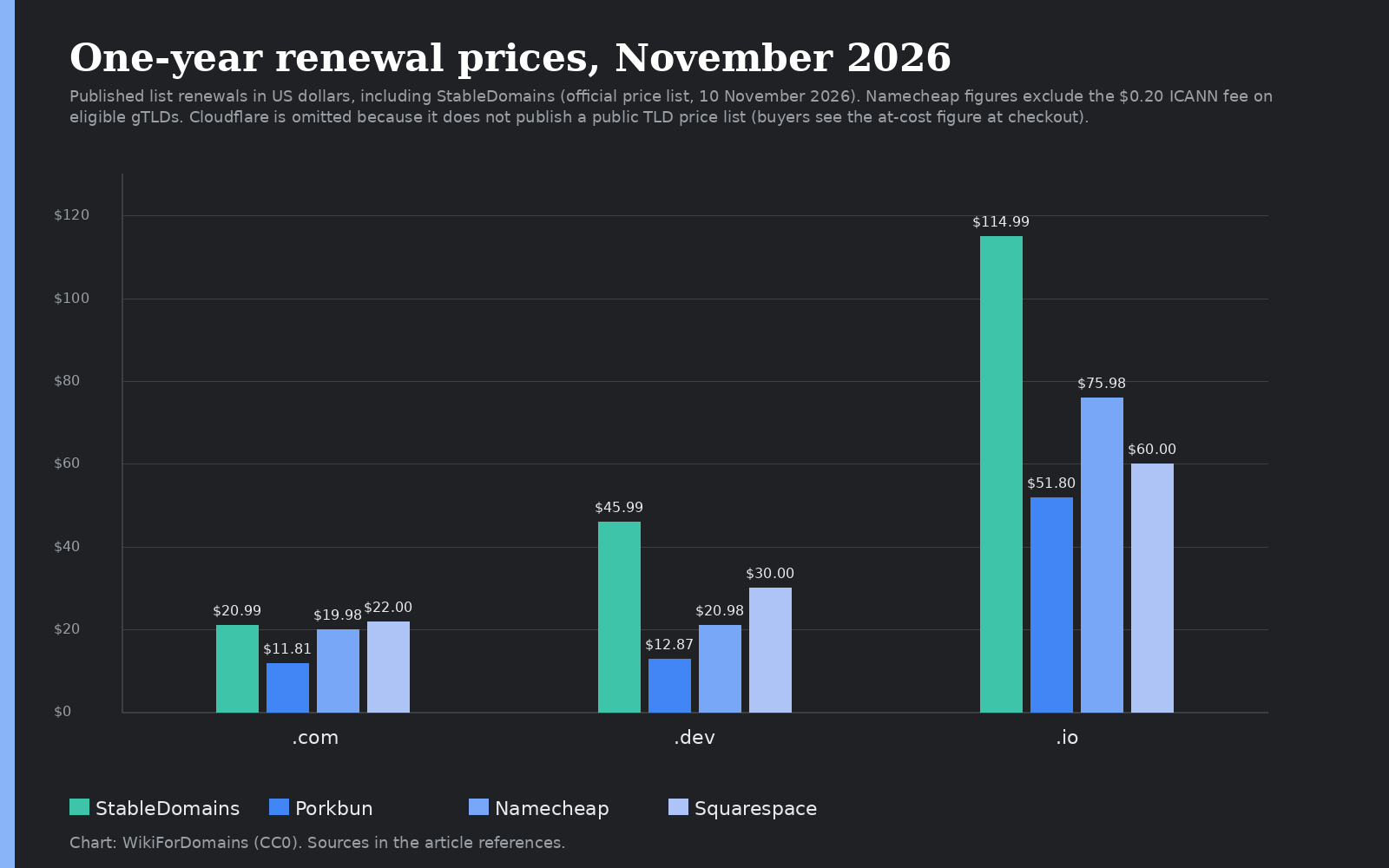
First-year sale prices are a poor guide to long-term cost. The chart shows published one-year renewal list prices for three popular endings, now including StableDomains. Cloudflare Registrar is omitted from the chart because it does not publish a public TLD price list; its documented policy is to charge the registry and ICANN list price with no registrar markup, shown at checkout and through its Check API.[5][8]
| Registrar | .com register / renew | .dev register / renew | .io register / renew | Source date |
|---|---|---|---|---|
| StableDomains | US$16.99 / US$20.99 | US$18.49 / US$45.99 | US$57.99 / US$114.99 | Official price list, 10 November 2026[21] |
| Porkbun | US$11.81 / US$11.81 | US$8.75 / US$12.87 | US$28.12 / US$51.80 | Public pricing API, 10 November 2026[1] |
| Cloudflare Registrar | At cost (registry + ICANN list price, no registrar markup). The live figure is shown in the dashboard and the Check API; Cloudflare does not publish a public TLD sheet. | Policy documentation[5][6][8] | ||
| Namecheap | US$12.08 sale (list US$15.98) / US$19.98[12] | US$10.98 sale (list US$15.98) / US$20.98 | US$29.98 sale (list US$65.98) / US$75.98 | Official TLD pages, 10 November 2026[11][13][14] |
| Squarespace Domains | US$10 sale / US$22 | US$30 / US$30 | US$60 / US$60 | Third-party tracker snapshot, 10 November 2026 — confirm at checkout[19] |
Namecheap also adds a mandatory US$0.20 ICANN fee on each registration, renewal or transfer of affected generic endings, including .com and .dev, at the time of purchase.[11] Porkbun’s API prices already include the fees it charges the customer. Optional coupon codes exist on some Porkbun operations; the table uses the un-couponed API defaults.
StableDomains
StableDomains is an “agent-first” registrar based in England. It sells, renews and transfers ICANN domain names with payment in USDC or USDT on several networks, via the x402 protocol, or by card, and registrations are placed through an ICANN-accredited registrar partner.[22][23] Every action in its web interface is also documented for software and AI agents through a REST API (OpenAPI 3.1), a Model Context Protocol server, dry-run quotes and idempotent orders.[23][24] Company profile: StableDomains.
On 10 November 2026 the official price list showed .com at US$16.99 for the first year and US$20.99 to renew, .dev at US$18.49 / US$45.99, and .io at US$57.99 / US$114.99, payable 1:1 in USDC or USDT; premium names are priced separately and the live quote is shown before payment.[21] WHOIS privacy is included where the registry allows it. Hosted DNS and custom nameservers are supported, including one-call DNS templates for hosts such as Vercel and Netlify.[23] People can sign in with an email link, a passkey or an Ethereum wallet (Sign-In with Ethereum).[23] The public documentation reviewed for this article does not describe a one-click DNSSEC control on its hosted DNS.
WikiForDomains is an independent encyclopedia and is not owned by StableDomains. Partner link (sponsored, nofollow): StableDomains.
Porkbun
Porkbun is an ICANN-accredited registrar based in Oregon. Its public JSON API does not require a minimum domain count to retrieve pricing and, with API keys, covers registration, DNS and DNSSEC operations. A dedicated pricing endpoint is unauthenticated.[1][2] Company background: Porkbun.
On 10 November 2026 the API listed .com registration, renewal and transfer at the same US$11.81, after the 1 November 2026 Verisign wholesale change. .dev and .io still used a lower first-year registration price than the renewal.[1] WHOIS privacy is free and enabled by default on eligible endings; a few country-code endings, such as .us, do not allow it.[3] The company’s security page documents account two-factor authentication, including security keys or passkeys, an authenticator app, or email.[4] Custom nameservers are supported, and DNSSEC can be enabled when using Porkbun nameservers or by publishing DS records for external DNS.
Porkbun is discussed here as a registrar, not as a promotional partner of this site.
Cloudflare Registrar
Cloudflare Registrar sells and renews domains at the amount charged by the registry and ICANN, with no registrar markup, and redacts personal WHOIS data where the registry permits it.[5][6][7] DNSSEC can be turned on in one click. Refunds are not offered on completed registrations, renewals or transfers, because those fees are passed through immediately.[6]
The operational trade-off is DNS: domains on Cloudflare Registrar must use Cloudflare nameservers. Third-party nameservers are not supported; if you need them, Cloudflare’s own FAQ says the domain has to move to another registrar. Subdomain delegation is possible, and Business or Enterprise plans can use custom-branded nameserver hostnames that still point at Cloudflare.[10] Transferring a name in likewise requires the zone already to be active on a Cloudflare full setup.[10]
A Registrar API beta can search, check live availability and price, and register a supported ending with a bearer token. As of the published beta notes, renewals, transfers and contact updates are not yet exposed, and only a subset of dashboard endings can be registered through the API.[8] Worked examples in that documentation show sample standard prices such as US$8.57 for a .com and US$10.11 for a .dev; those examples may predate later registry changes (including the 1 November 2026 .com wholesale increase) and should not be treated as a current price list.
Transferring out follows the usual unlock-and-auth-code path. Cloudflare can approve the gaining registrar’s request immediately, or the transfer auto-approves on the fifth day. The standard 60-day restriction applies after a registration, a prior transfer, or a WHOIS registrant change — even if the data is redacted.[9]
Namecheap
Namecheap publishes first-year, renewal and transfer columns on each ending’s product page, which makes the sale-versus-renewal gap visible before checkout. After 1 November 2026 its regular .com registration and transfer list price is US$15.98 a year and the renewal is US$19.98, before the US$0.20 ICANN fee; first-year sale prices on 10 November 2026 were lower than those list figures.[11][12] .dev renewed at US$20.98 and .io at US$75.98 on the same day’s official pages.[13][14]
WHOIS privacy is included for life on eligible endings, provided through Withheld for Privacy; some country-code endings cannot use it.[11] Free BasicDNS includes DNSSEC on eligible names when the domain stays on Namecheap DNS.[11] Custom nameservers are supported. Account two-factor authentication is available.
The XML API can check availability, register and renew names, and edit DNS hosts. A free sandbox is open for testing. Production API access requires at least one of: 20 domains on the account, a US$50 account balance, or US$50 spent in the previous two years, plus at least one whitelisted IPv4 address. Support can be asked to waive the threshold.[15][16]
Squarespace Domains
Squarespace Domains is aimed at customers who already use, or plan to use, the Squarespace site builder. Official transfer documentation states that eligible domains include WHOIS privacy, account two-factor authentication, Let’s Encrypt TLS, domain locking, and DNSSEC, and that a transfer in extends the registration by a year at the ending’s transfer price.[18] Independent price trackers on 10 November 2026 listed a promotional .com first year at US$10 with a US$22 renewal, and flat US$30 and US$60 prices for .dev and .io respectively; those figures should be confirmed on the live checkout because Squarespace does not present a single public API price sheet in the same way Porkbun does.[19]
Developer automation is narrower than at the other three. Squarespace documents a reseller domains API for partners who resell names — listing domains, toggling privacy, and editing nameservers or DNS records — not a general customer registration API comparable to Porkbun or Namecheap. Contact and status changes still have to be made in the Squarespace UI.[20]
Like Porkbun and Cloudflare Registrar, Squarespace Domains is described here only as a product, not as a promotional partner.
Other registrars developers often consider
Plenty of other accredited registrars expose APIs or bulk tools. NameSilo is often used for larger portfolios and bulk workflows; see the domain registrar guide and Domain Lab for current partner pricing when the programme is active. WikiForDomains is an independent encyclopedia and is not owned by the registrars described in this article.
Which registrar fits which job
- Agent-driven or API-first registration, including stablecoin or x402 checkout. StableDomains publishes a REST API, an MCP server and x402 payment, plus a public TLD price list, and accepts USDC, USDT or card. That combination is the reason it is listed first among the write-ups above; it is not a claim that it is the cheapest or the only option.
- Scripted registration and DNS from the first account, with a simple JSON API. Porkbun’s JSON API and unauthenticated price list are straightforward to wire into a small tool. Cloudflare’s API is capable for registration on the endings the beta supports, but renewals and transfers were still dashboard-only in the published beta notes.[2][8]
- Lowest long-term .com or .dev invoice, if you are willing to use the registrar’s DNS. Cloudflare Registrar’s at-cost policy is designed for that case. The nameserver restriction is the main reason not to choose it.[5][10]
- A mid-size account that already uses Namecheap for email or hosting, and can meet the API threshold. The published renewal column is clear, privacy is included on eligible endings, and the sandbox exists even before production API access is granted.[15][16]
- A marketing or documentation site that will live on Squarespace anyway. Keeping the domain at Squarespace Domains avoids a nameserver cut-over, at the cost of weaker first-party automation and, on the November 2026 snapshots, higher renewals than Porkbun for the three endings in the table.
- Names that must sit on Amazon Route 53, NS1, or another specialist DNS network. Avoid Cloudflare Registrar unless you can delegate only a subdomain. StableDomains and the other three generally allow custom nameservers.
None of these choices is universal. A team can also split the problem: register at one registrar and host DNS elsewhere, except where the registrar forbids that split.
Transfers
Most generic endings follow the same outline: the name must be unlocked, you copy an authorisation (EPP) code, and the gaining registrar requests the transfer. A successful transfer of a typical generic ending adds one year and charges at least that year’s registration or transfer price. Country-code endings sometimes differ (.uk and .nz, for example, do not add a year at Cloudflare).[10]
A name generally cannot move if it was registered, transferred, or had its registrant details changed in the previous 60 days. If you renew and then transfer within 45 days, some registries will still charge the gaining registrar for a year but will not actually extend the expiry; the previous registrar may owe a refund of that prepaid year.[10] Waiting out those windows is usually cheaper than opening a dispute later. Practical steps: Domain transfer.
Frequently asked questions
Is the cheapest first-year offer usually the cheapest registrar?
No. Several endings in this comparison advertise a first-year discount and a higher renewal. Compare the renewal column, and multiply it by the number of years you expect to keep the name. A flat at-cost or flat retail renewal is easier to budget than a teaser price.
Can I use my own nameservers at every registrar in this article?
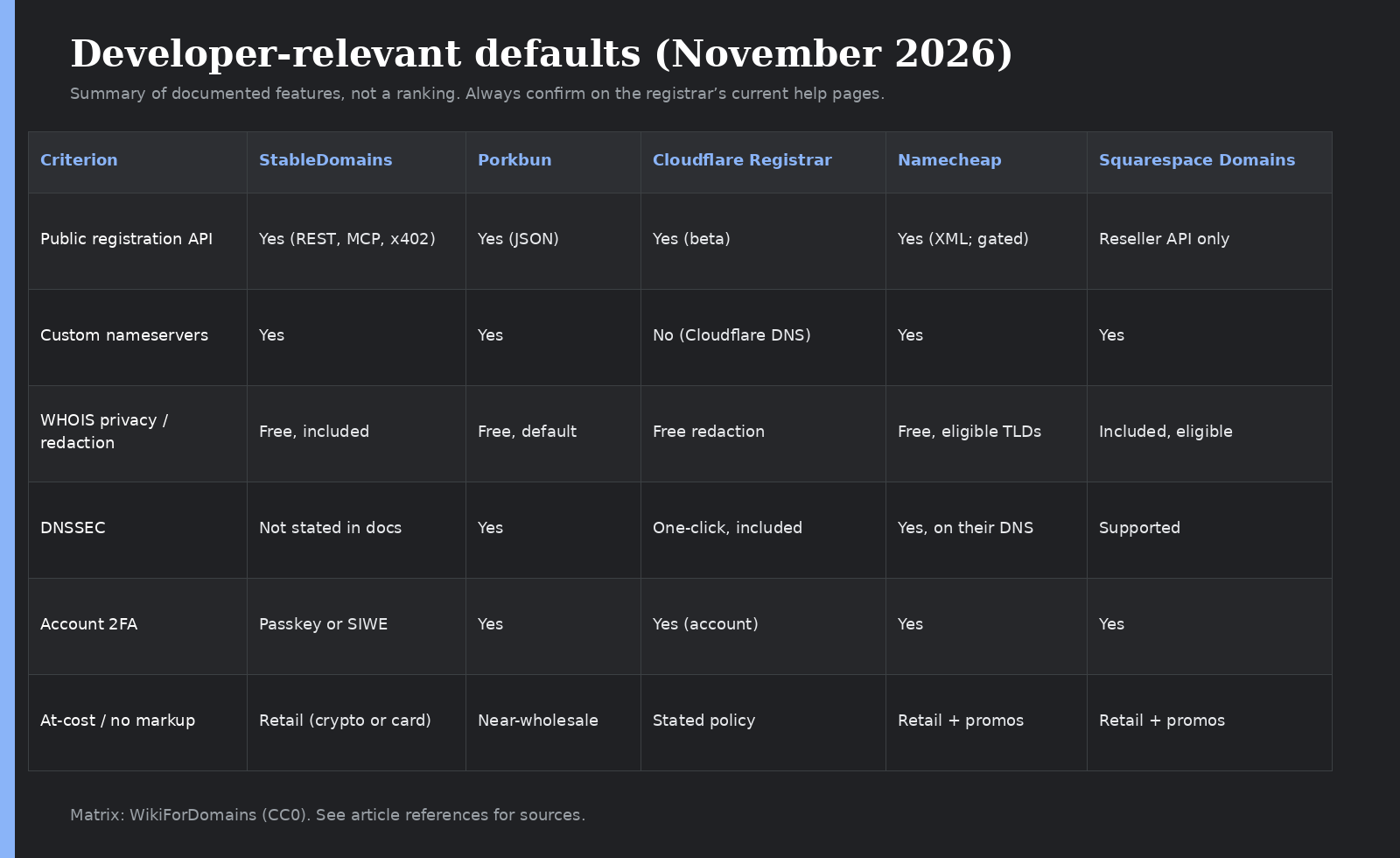
No. Cloudflare Registrar requires Cloudflare nameservers. StableDomains, Porkbun, Namecheap and Squarespace Domains allow custom nameservers, with the usual caveat that registrar-bundled forwarding or DNSSEC toggles may apply only while you use that registrar’s DNS.
Do I get WHOIS privacy without paying extra?
On eligible endings, yes, at all five: StableDomains (included), Porkbun (default privacy service), Cloudflare (redaction), Namecheap (Withheld for Privacy, free for life on eligible names) and Squarespace (included). Some country-code endings prohibit privacy; the registrar should warn at checkout.
Which of these has the most complete public registration API?
StableDomains publishes a REST API, MCP server and x402 checkout without a published domain-count gate, which suits agents and scripted flows. For a conventional new account, Porkbun’s JSON API is the least gated of the remaining set. Namecheap has a full production API once an account meets its published threshold, and a free sandbox before that. Cloudflare’s registrar API is in beta and does not yet cover renewals or transfers. Squarespace’s documented domains API is a reseller interface rather than a general end-user registration API.
Does WikiForDomains recommend one of these companies?
No. This is a sourced comparison, not a recommendation. The Domain Lab on this page shows live register and renewal quotes only from the site’s active paying partners; that placement is an affiliate disclosure, not an editorial ranking.
Where to buy
WikiForDomains does not sell domains. The Domain Lab below compares register and renewal prices from this site’s active paying registrar partners. StableDomains is listed first when it is an active partner, followed by other active partners such as Namecheap and NameSilo. WikiForDomains is an independent encyclopedia and is not owned by these registrars. Registrars discussed above that are not active partners are not included in the Lab or in other promotional slots; use their official sites if you want to buy from them.
Partner links (sponsored, nofollow): StableDomains, Namecheap, NameSilo.
See also
- Porkbun
- Domain registrar
- Domain registration APIs
- Domain Lab
- Cheap domains
- Domain transfer
- Domain privacy
- .com
- .io
- Domain name search
- What is a domain name
- StableDomains
References
- Porkbun API v3 — POST /api/json/v3/pricing/get (unauthenticated; retrieved 10 November 2026 for .com, .dev and .io). Documentation: porkbun.com/llms/pricing.
- Porkbun API v3 documentation.
- Porkbun Knowledge Base — How to configure WHOIS privacy service (updated 17 July 2026).
- Porkbun — Security and phishing (account two-factor authentication options).
- Cloudflare Docs — Registrar overview (at-cost registration and renewal; one-click DNSSEC).
- Cloudflare Docs — Registrar FAQ (billing, no refunds on at-cost transactions, transfer year, 45-day renewal window).
- Cloudflare Docs — WHOIS redaction.
- Cloudflare Docs — Registrar API (beta workflow, limitations, and sample Check/Search prices).
- Cloudflare Docs — Transfer a domain out from Cloudflare.
- Cloudflare Docs — Registrar FAQ (mandatory Cloudflare nameservers; transfers require a full setup; 60-day lock).
- Namecheap — Register a .com domain (prices, privacy, DNSSEC, US$0.20 ICANN fee; retrieved 10 November 2026).
- Namecheap Knowledge Base — .com price change, 1 November 2026 (regular registration/transfer US$15.98; renewal US$19.98, excluding the ICANN fee).
- Namecheap — Register a .dev domain (retrieved 10 November 2026).
- Namecheap — Register a .io domain (retrieved 10 November 2026).
- Namecheap — Intro to API for developers (sandbox, production URL, IPv4 whitelist).
- Namecheap Knowledge Base — API FAQ (production access: 20 domains, or US$50 balance, or US$50 spent in two years).
- Namecheap domain pricing index.
- Squarespace Domains — Transfer a domain (included privacy, two-factor authentication, DNSSEC, one-year extension on transfer).
- TopLevelData — Squarespace registrar prices (snapshot dated 10 November 2026; unofficial tracker, confirm at checkout).
- Squarespace Developer Platform — Reseller domains API overview.
- StableDomains — Domain prices: register, renew and transfer (retrieved 10 November 2026; .com, .dev and .io figures used in the table and chart).
- StableDomains — About (agent-first design, ICANN-accredited registrar partner, payment methods).
- StableDomains — llms.txt (API, MCP, DNS, nameservers, sign-in, pricing API).
- StableDomains — Developer hub (REST API, MCP server, CLI).
- StableDomains — x402.