x402
x402 is an open payment protocol that uses the HTTP status code 402 Payment Required so a client—human software or an AI agent—can pay for a web resource inside the same request flow, typically with a stablecoin such as USDC. Coinbase published the protocol in May 2025; as of April 2026 the Linux Foundation hosts the x402 Foundation as a vendor-neutral home for the standard.[1][2]
Related: AI agent economy, Buy a domain with USDC, Buy domain with crypto, AI agent domain registration.
HTTP 402 before x402
HTTP 402 Payment Required has existed since early HTTP/1.1 drafts and remains listed in current HTTP Semantics (RFC 9110) as reserved for future use. MDN describes it as a nonstandard reserved code originally intended for digital cash or micropayment systems, with no single browser-supported convention.[3] Until the mid-2020s it saw only ad-hoc use. x402 proposes a concrete, machine-readable payment handshake on top of that status code.
History
- 6 May 2025 — Coinbase announces x402 as an open standard for stablecoin payments over HTTP, citing earlier micropayment experiments (including 21.co) and lower fees on L2 networks such as Base.[1]
- 23 September 2025 — Cloudflare announces a partnership with Coinbase to create the x402 Foundation, ships Agents SDK / MCP payment helpers, and proposes a deferred-payment scheme for batched or delayed settlement (including pay-per-crawl style use).[4]
- 2 April 2026 — The Linux Foundation announces it is launching the x402 Foundation and receiving the protocol contribution from Coinbase; initial governing development is described as involving Coinbase, Cloudflare and Stripe, with a long list of companies expressing support.[2]
How it works
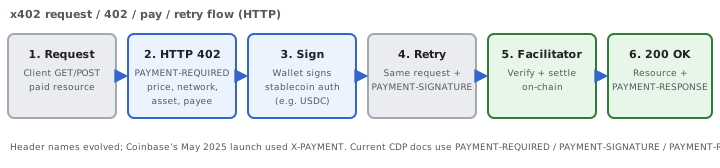
Coinbase Developer Platform (CDP) documentation describes a request–quote–pay–settle loop:[5]
- The client requests a paid resource.
- The server answers with HTTP 402 and payment requirements (price, payee, accepted networks/assets/schemes), commonly carried in a
PAYMENT-REQUIREDheader. - The client constructs a signed payment payload with its wallet (often an EIP-3009
transferWithAuthorizationfor USDC so the facilitator can submit gaslessly). - The client retries the same request with a
PAYMENT-SIGNATUREheader. - The server verifies the payload locally or via a facilitator
/verifyendpoint, fulfills the work if valid, then settles via the facilitator/settle(or on-chain itself). - The server returns HTTP 200 with the resource and a
PAYMENT-RESPONSEconfirming settlement.
Coinbase’s May 2025 launch post named the client payment header X-PAYMENT and the confirmation X-PAYMENT-RESPONSE. Later CDP and open-spec documentation use the unprefixed PAYMENT-* names above; implementations should follow the live spec and the seller’s 402 response.[1][5][6]
Facilitators, networks and SDKs
A facilitator is an optional service that verifies signatures and broadcasts settlement without taking custody of the buyer’s funds. Cloudflare’s Agents docs point examples at the public facilitator at https://x402.org/facilitator (operated by Coinbase) and note that multiple facilitators exist across networks.[7] CDP documents a Coinbase-hosted facilitator with support spanning several chains (documentation as of late 2026 includes Base and Solana among production paths) and states that CDP has processed more than 100 million x402 payments across Base and Solana.[8]
The protocol is designed to be network- and asset-flexible; USDC on Base is the most commonly cited starter path. Official and community SDKs include TypeScript, Go and Python clients/servers listed in Coinbase/x402 Foundation documentation.[8][6]
Adoption (verified examples)
- Cloudflare — Agents SDK and MCP integrations that can pay or charge via x402; foundation co-launch with Coinbase.[4][7]
- Linux Foundation x402 Foundation — governance home from April 2026; public membership interest list includes AWS, Circle, Google, Mastercard, Microsoft, Shopify, Solana Foundation, Stripe, Visa and others.[2]
- Domain registrars — Porkbun documents USDC on Base via Coinbase Business / x402 for API purchases (
payWith: "usdc"on create/renew/transfer) and credit top-ups.[9] StableDomains documents x402-paid endpoints and registration (USDC on Base) alongside multi-chain transfers and cards.[10]
Relevance to domains
Agents that register or renew DNS names need a way to pay without a human completing a card form. x402 lets a registrar return HTTP 402 with an exact USDC quote; a wallet-equipped agent pays and retries. That pattern appears in Porkbun’s API guide and StableDomains’ x402 documentation as of November 2026.[9][10] It complements, rather than replaces, account credit, Stripe checkout, or plain on-chain transfers. See also AI agent domain registration.
Limitations and criticisms
- Stablecoin / chain dependency — many early deployments centre on USDC and a short list of chains; fiat and card settlement need additional schemes (Cloudflare’s deferred proposal; card-network agent programmes described under the agent economy).
- Facilitator trust — sellers that outsource verify/settle depend on facilitator availability, policy (for example sanctions screening) and correct broadcast.
- Irreversibility and disputes — on-chain settlement differs from card chargebacks; failed fulfilment after payment may leave funds as merchant credit (Porkbun documents this for post-payment registry failures).[9]
- Spec churn — header names and schemes evolved between the May 2025 launch post and later CDP / Foundation specs; clients must follow the live 402 payload.
- Not a full commerce stack — x402 settles a resource request; cart UX, identity, and “user authorized this agent” proofs are handled by adjacent protocols such as ACP and AP2 (see AI agent economy).
See also
- AI agent economy
- Buy a domain with USDC
- Buy a domain with USDT
- Porkbun
- StableDomains
- AI agent domain registration
References
- "Introducing x402: a new standard for internet-native payments". Coinbase. 6 May 2025. Retrieved 9 November 2026.
- "Linux Foundation is Launching the x402 Foundation and Welcoming the Contribution of the x402 Protocol". The Linux Foundation. 2 April 2026. Retrieved 9 November 2026.
- "402 Payment Required". MDN Web Docs. Retrieved 9 November 2026.
- "Launching the x402 Foundation with Coinbase, and support for x402 transactions". The Cloudflare Blog. 23 September 2025. Retrieved 9 November 2026.
- "How x402 works". Coinbase Developer Platform. Retrieved 9 November 2026.
- "coinbase/x402" (development fork; points to x402 Foundation repo). GitHub. Retrieved 9 November 2026.
- "x402". Cloudflare Agents docs. Retrieved 9 November 2026.
- "Overview" (x402). Coinbase Developer Platform. Retrieved 9 November 2026.
- "Pay with USDC (x402): buy directly, or add credit". Porkbun. Retrieved 9 November 2026.
- "x402 on StableDomains". StableDomains. Retrieved 9 November 2026.