What is a domain name
| Domain name | |
|---|---|
| Also known as | Domain name |
| Purpose | Human-readable Internet name mapped via DNS |
| Governing bodies | ICANN, IANA |
| Name space root | DNS root zone |
A domain name is a human-readable label that identifies a resource on the Internet. Instead of remembering numeric IP addresses, people and software use names such as example.com. The Domain Name System (DNS) translates those names into addresses and other records that computers need to connect.[1]
How DNS works
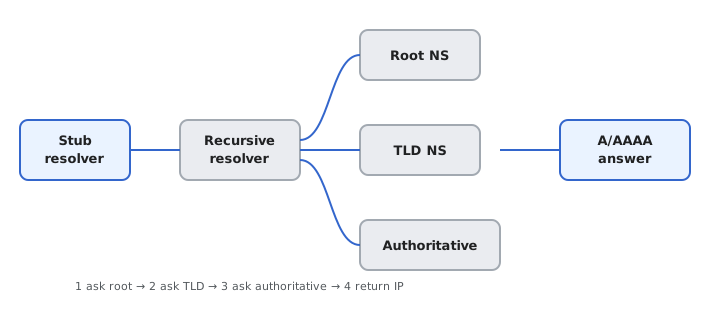
When software looks up a name, a stub resolver on the device usually asks a recursive resolver (often run by an ISP or public DNS provider). That resolver walks the DNS hierarchy: it queries a root nameserver, then a TLD nameserver (for example for .com), then the authoritative nameserver for the registered domain, which returns the final answer (such as an A or AAAA record).[1][2]
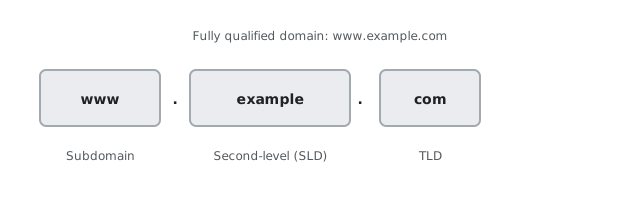
Parts of a domain name
- Top-level domain (TLD) — the right-most label (
.com,.uk,.ai). Managed under policies coordinated by ICANN/IANA for gTLDs and by country managers for many ccTLDs.[3] - Second-level domain (SLD) — the label registered by a customer (the
exampleinexample.com). - Subdomain — optional left-hand labels (
www,mail) created by the registrant in DNS.
Registry, registrar, and registrant
- Registry — operates a TLD zone (for example Verisign for
.com/.net).[4] - Registrar — an ICANN-accredited (or ccTLD-accredited) company that sells registrations to the public.
- Registrant — the person or organisation that holds the registration contract for a name.
See also practical buying guides: How to buy a domain, Domain registrar, and Domain name lifecycle.
See also
- StableDomains
- History of the Domain Name System
- The domain name industry
- Domain registrations worldwide
- .com
- WHOIS lookup
- Best domain registrars for developers in 2026