Buy a domain anonymously with crypto
Buying a domain anonymously with cryptocurrency usually means combining (1) a payment method that does not use a card or bank transfer at checkout with (2) a registrar or reseller that minimises public WHOIS exposure and, in some cases, does not run routine government-ID KYC. These two layers are easy to confuse. Payment privacy is not the same as ownership privacy, and neither erases legal duties that attach to domain names used for unlawful activity.[1][2]
Background: Domain privacy, WHOIS lookup, Buy domain with crypto, Buy a domain with USDT.
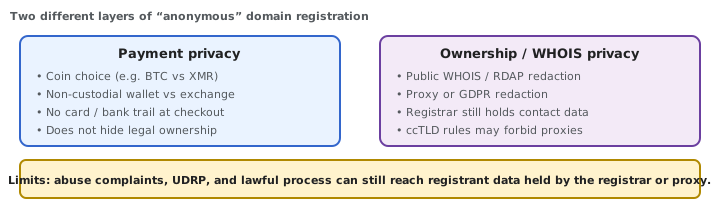
Payment privacy versus ownership privacy
- Payment privacy — paying with crypto (especially from a non-custodial wallet, or with a privacy coin such as Monero) can avoid putting cardholder data into the registrar checkout. Transparent chains such as Bitcoin still leave a public ledger trail.
- Ownership / WHOIS privacy — public RDAP/WHOIS may show a proxy, redacted fields (common under GDPR for natural persons), or a privacy service’s contacts. The registrar or privacy provider still holds contact data needed to operate the name.[1]
Some privacy resellers (for example Njalla and IncogNET) register the domain under the company’s own registrant details and grant the customer contractual use rights; others keep the customer as registrant while hiding details from the public directory.[3][4]
ICANN data accuracy and legal limits
For gTLDs, ICANN’s registration data policies require registrars to collect and maintain accurate registrant contact information even when that information is not published. HostCay’s own service agreement states this plainly: inaccurate data can lead to suspension, and WHOIS privacy “does not hide it from the registry, ICANN, or from lawful legal process”.[2] Country-code TLDs may ban privacy proxies entirely or require local presence. Abuse desks, UDRP /URS trademark procedures, and court or law-enforcement process can still compel disclosure of account records held by the registrar or proxy.
This article describes lawful privacy practices (reducing spam exposure, avoiding unnecessary public doxxing of home addresses). It is not guidance for evading investigations or using domains for fraud, phishing or other crime.
KYC versus no-KYC signup
“No KYC” in this market usually means email-only account creation without a routine passport upload. Providers still may request more information for abuse, fraud or unusual orders, and payment processors in the middle of a checkout can impose their own identity checks above certain amounts.
Coins and wallets
- Privacy coins (e.g. Monero / XMR) — stronger payment-layer privacy when the merchant accepts them in-house (Njalla, IncogNET, TheOnionHost and others list XMR).[3][5][6]
- Transparent coins and stablecoins (BTC, ETH, USDT, USDC) — widely accepted; ledger analysis and exchange KYC on the funding side can still link a payment to an identity.
- Non-custodial wallets — avoid binding the purchase to a centralised exchange account at the moment of payment; funding the wallet from a KYC exchange earlier still creates an upstream trail.
Providers (verified claims)
As of November 2026, the following operators publicly document crypto payment plus a privacy-oriented registration posture. Marketing language such as “complete anonymity guaranteed” should be read against the legal limits above.
| Provider | Verified posture | Source |
|---|---|---|
| HostCay | Email-only signup, crypto (BTC, XMR, USDT, ETH and more), free WHOIS privacy; TOS stresses accurate ICANN data and legal-process limits. | [7][2] |
| HostSailor | Domain registration with Bitcoin and 50+ coins via CoinGate; ID-protection add-on described on domain pages (not a pure proxy-registrar model). | [8] |
| IncogNET | Private registration using IncogNET’s registrant details; BTC, XMR, LTC, Dash, DOGE processed in-house; email-only accounts; manual domain approval / AUP screening. | [4][5] |
| MonstaDomains | Markets no-KYC, crypto-only payments (claims 350+ coins including BTC, ETH, XMR, USDT, USDC) and free WHOIS privacy. | [9] |
| MonsterMegs | 850+ TLDs, free WHOIS privacy, anonymous sign-up and crypto payments advertised on the home page. | [10] |
| Njalla | Privacy shield: Njalla holds registration, customer has usage rights; accepts BTC, LTC, XMR, ETH and PayPal; email or XMPP signup. | [3] |
| TheOnionHost | Email-only standard orders; BTC, XMR, ETH, USDT and others; domain registration available in billing cart; AUP and local-law notice policy published. | [6] |
Mainstream registrars such as Porkbun and StableDomains accept crypto or stablecoins and often include free WHOIS privacy, but they are not marketed as no-KYC anonymous registrars and still collect account contact data.
Practical checklist (lawful use)
- Decide whether you need public WHOIS redaction, a proxy registrant, or both.
- Check whether the chosen TLD allows privacy proxies.
- Prefer a payment path you understand (network, exact amount, non-custodial wallet if that matches your threat model).
- Keep renewal reminders working — an expired domain is a privacy and availability failure.
- Expect abuse and legal process to reach the operator that holds the registration records.
See also
- Domain privacy
- WHOIS lookup
- Buy domain with crypto
- Buy a domain with USDT
- Buy a domain with USDC
- x402
- AI agent economy
References
- "WHOIS". ICANN. Retrieved 9 November 2026.
- "Service Agreement, Legal & Privacy Policy". HostCay. Retrieved 9 November 2026.
- "Frequently Asked Questions". Njalla. Retrieved 9 November 2026.
- "How the private registration works". IncogNET Knowledgebase. Retrieved 9 November 2026.
- "What payment methods do you accept?". IncogNET Knowledgebase. Retrieved 9 November 2026.
- "No-KYC hosting with crypto payments". TheOnionHost. Retrieved 9 November 2026.
- "Offshore Domain Names - Privacy Domains". HostCay. Retrieved 9 November 2026.
- "Payment Methods". HostSailor. Retrieved 9 November 2026.
- "No KYC Domain Registration - Private Domains with Crypto". MonstaDomains. Retrieved 9 November 2026.
- "MonsterMegs | Domain Registration & LiteSpeed Web Hosting". MonsterMegs. Retrieved 9 November 2026.