History of the Domain Name System
| DNS history | |
|---|---|
| Inventor | Paul Mockapetris |
| First RFCs | RFC 882 / RFC 883 (1983) |
| Superseded by | RFC 1034 / RFC 1035 (1987) |
| Early steward | Jon Postel (IANA functions) |
| First .com | symbolics.com (1985) |
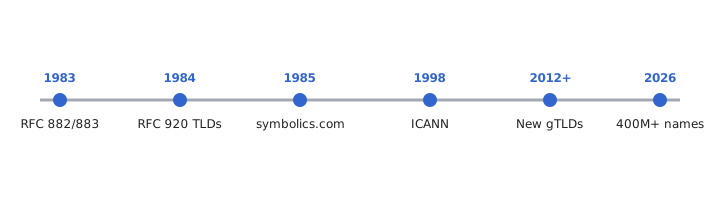
The Domain Name System replaced earlier host tables with a distributed, hierarchical naming system. In 1983, Paul Mockapetris published RFC 882 and RFC 883, defining DNS concepts and implementation. Those documents were later refined as RFC 1034 and RFC 1035 (1987), which remain foundational references.[1][2]

From hosts.txt to DNS
Before DNS, networked hosts relied on a centrally maintained hosts file. Growth of the early Internet made that approach impractical. DNS introduced delegated zones, caching, and a global root so organisations could manage their own subtrees while remaining globally unique.[1]
Jon Postel and early IANA
Jon Postel performed many of the early Internet Assigned Numbers Authority (IANA) functions, including coordination of protocol parameters and name/address assignments, until institutional arrangements later centred on ICANN (founded 1998) with IANA functions operated under community oversight.[3][4]

Early TLDs and symbolics.com
RFC 920 (1984) described initial top-level domains including .com, .edu, .gov, .mil, and .org. The first registered .com name is widely documented as symbolics.com (1985), associated with Symbolics, Inc.[5]
Commercialisation and new gTLDs
The 1990s brought shared registration systems and commercial registrars. ICANN’s new gTLD program (applications from 2012) greatly expanded the TLD landscape beyond the early generics and country-code domains.[4]